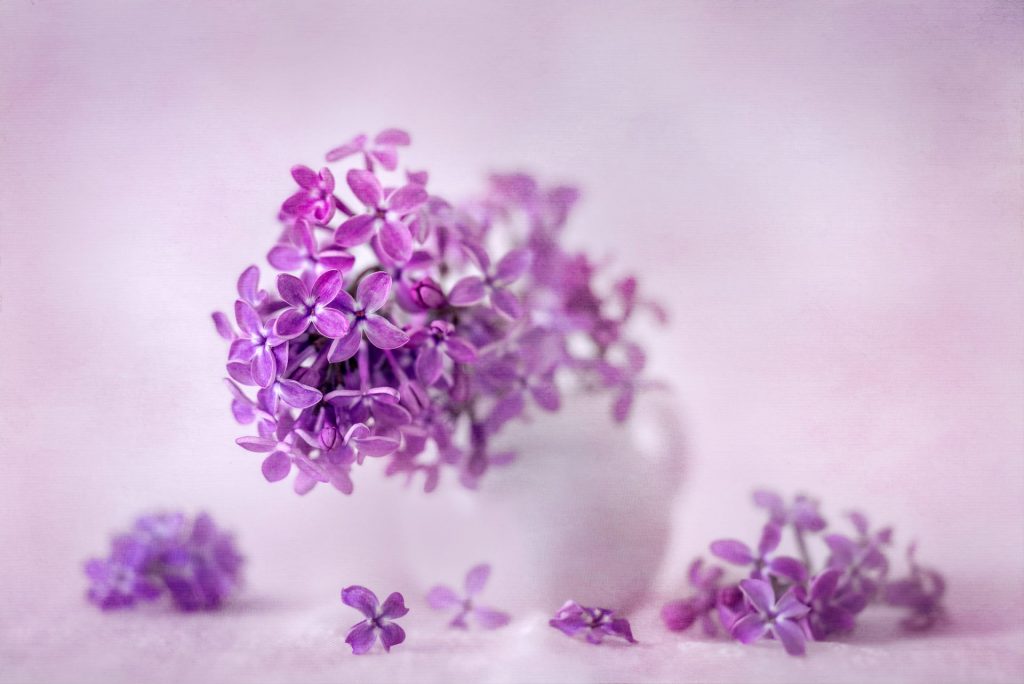
Creativity is allowing yourself to make mistakes. Art is knowing which ones to keep.
Scott Adams
Scott Adams (1957-) is an American author and cartoonist.
To read more quotes, click here.
Creativity is allowing yourself to make mistakes. Art is knowing which ones to keep.
Scott Adams
Scott Adams (1957-) is an American author and cartoonist.
To read more quotes, click here.

Creative work needs solitude. It needs concentration, without interruptions. It needs the whole sky to fly in, and no eye watching until it comes to that certainty which it aspires to, but does not necessarily have at once. Privacy, then. A place apart – to pace, to chew pencils, to scribble and erase and scribble again.
Mary Oliver
Mary Oliver (1935-2019) was a Pulitzer Prize-winning American poet popular for her brief and poignant poems exploring the links between nature and the spiritual world.
To read more quotes, click here.

There is, I hope, a thesis in my work: we may encounter many defeats, but we must not be defeated. That sounds goody-two-shoes, I know, but I believe that a diamond is the result of extreme pressure and time. Less time is crystal. Less than that is coal. Less than that is fossilized leaves. Less than that it’s just plain dirt. In all my work, in the movies I write, the lyrics, the poetry, the prose, the essays, I am saying that we may encounter many defeats—maybe it’s imperative that we encounter the defeats—but we are much stronger than we appear to be and maybe much better than we allow ourselves to be.
Maya Angelou (1928–2014), was an American poet, storyteller, and autobiographer.
To read more quotes, click here.

Creativity thrives on constraints; I said it many times. Social distancing and closed meeting places hurt creativity, it’s true. But we cannot wait until life is back to normal (or to the new normal, rather) to be creative. We have to work with what we have, right here, right now. In solitude. Hurting. Hoping.
We have to become our own support system, our own cheerleaders. Acknowledge the hurt, the anxiety, the not knowing. And move past them. Otherwise, we’d become stuck.
In a scene from “Harry Potter and the Sorcerer’s Stone,” Harry, Ron, and Hermione struggle to free themselves from a giant plant. The more they struggle, the more the plant tightens around them. Once they relax and stop moving, they’re free.
We have to stop struggling to become free.
If you liked this post, share it on your preferred social network or forward it to a friend.
I had a good workday yesterday, keeping to my to-do-list and ticking off all the items. That’s the power of a list, that sentiment of accomplishments that fills you up when you’ve crossed all points. (Here’s a good read on the subject of checklists).
But it was more than that. I was pleased with the work; I was pleased with myself. I looked at my day and congratulated myself.
It doesn’t happen often. Life usually happens. An unexpectedly early delivery, computer breakdown, a distressing phone call. There’s always something, and I’ve learned to juggle priorities. As long as I focus on my priorities, I can handle disruptions. If I’ve done my top three priority items on my list, I’m happy about my day.
Crossing off all the items and feeling good about the work, that one chapter, or those two photos, now that’s a rare combination.
Because creative work cannot easily be judged as, say, a piece of …
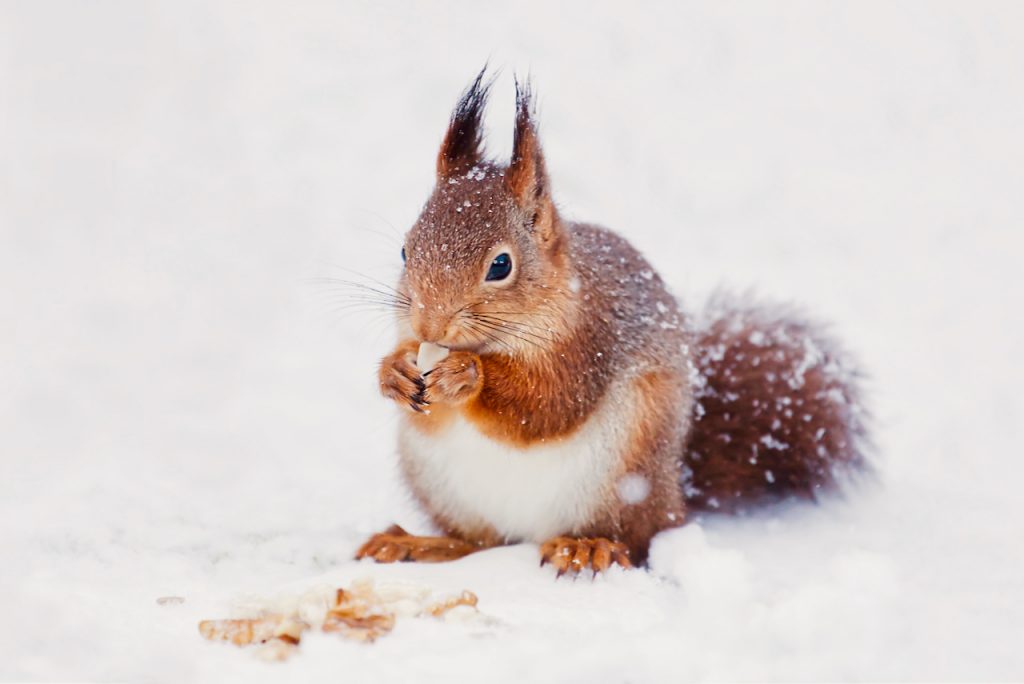
Speaking of interruptions, the little red squirrel came by, and I ran out to take photos. Now I have to re-focus and return to my text.
It’s easy to decide if a product such as a toaster meets the quality standards. But how do you decide whether an artwork is good? Herein lies the difficulty. The doubt creeps in. Small mistakes or minor flaws are enlarged until you only see them. Is this really the best I could do? Maybe if I had more time, I could have … I should have …
Euphoria and doubt, back and forth, the perpetual tide and ebb of any creative process.
If you liked this post, share it on your preferred social network or forward it to a friend.
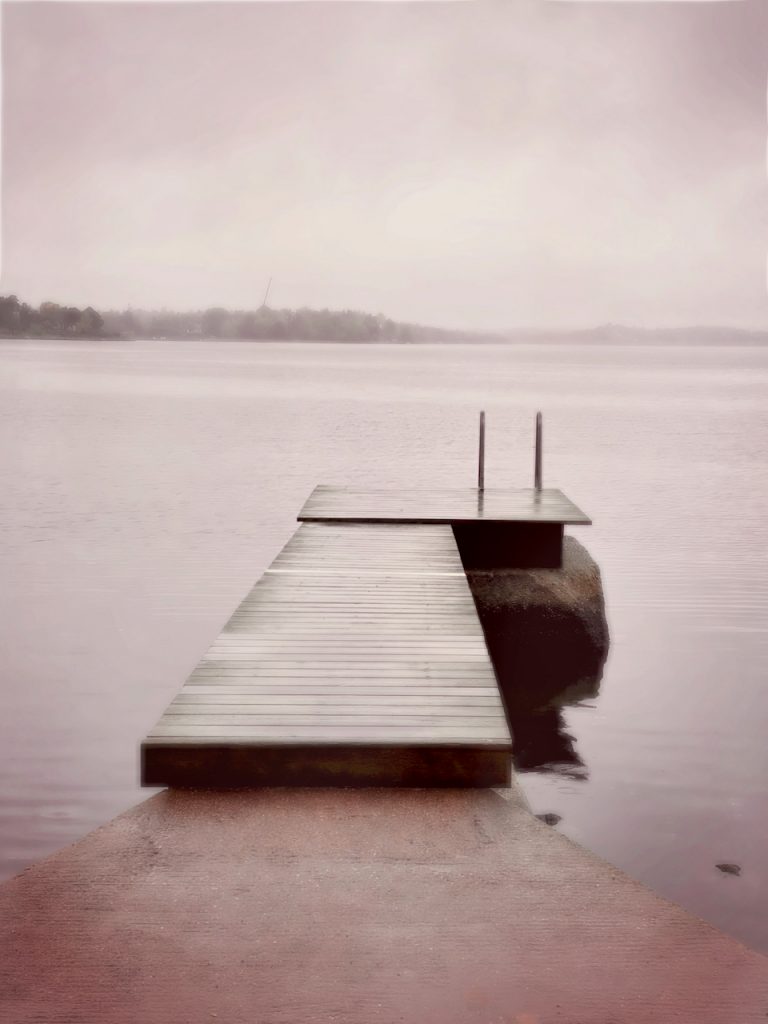
This post is about creativity, constraints and making do with what you have.
I had forgotten how dark it gets in this country after years of living in Switzerland. Last year doesn’t really count as re-acclimatization to Scandinavian darkness as we moved in at the end of October, had plenty of things to manage because of the move, and then went to Australia mid-December.
Darkness is so oppressive now; it feels like we’re living in a perpetual twilight zone. Even at noon, there’s not enough light to take decent photos. Outside, that is.
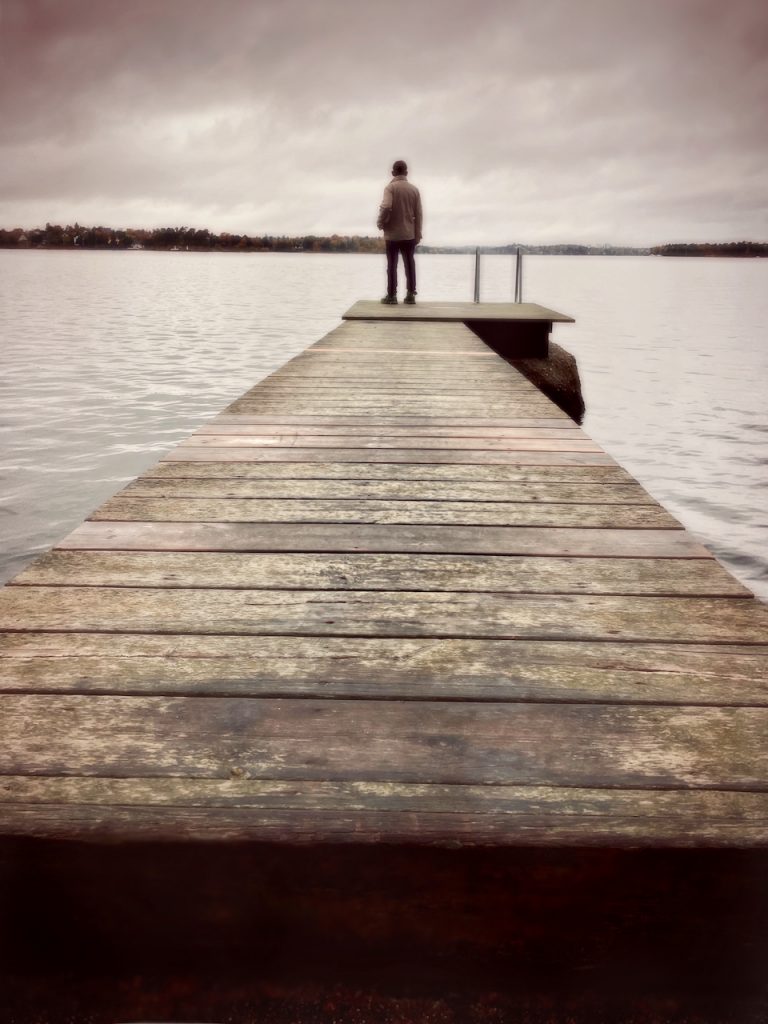
I use to go for a walk at noon, to get some fresh air and daylight. Especially daylight. I always preach creativity thrives on constraints, and so I’m forcing myself to find something to photograph during my walks. Sometimes I bring my Canon 5D if there’s enough light to give it a try; otherwise, I always have my iPhone.
On some overcast days, this really becomes an exercise in creativity as the whole world seems to be blanketed in 50 shades of gray (pun intended).
The salvation then is in post-processing. I like to keep things simple. The photos above were taken with an iPhone and processed quickly with Snapseed. That’s it; it took me only a couple of minutes. No masterworks, I’m the first to admit. But much better looking than the original photos.
And since creativity thrives on constraints, I’m considering doing a 365 project, when you take and post one photo a day, every day, for a whole year. January 1st is around the corner, a good date to start a 365 project, don’t you think? It should be fun.
If you liked this post, share it on your preferred social network or forward it to a friend.
To read more posts on photography, click here.
Taking my own advice, I continue writing, despite alarmist media reports, gradual movement restrictions in Sweden, and my own distraction. Creativity is hard work at any time, not only during a pandemic. So, I sit down every morning, turn on my computer, and start typing.
I’m writing a short story at the moment. I was working on a novel but decided to pause it for a while. With a story, I can (hopefully) be done quickly, and that would give me a feeling of accomplishment. It’s also good fun writing it, and fun is a good thing these days.
The funny thing (see what I did there?) is that I had completely forgotten about it. I had a few loose ideas, but I was working on a different thing at the time, so I just wrote them down, saved them in a “Writing Ideas” folder for later, and then promptly forgot about it.
A few days ago, two years later, I was looking for something else and came across this file titled “The Author.” I had absolutely no idea what it was. I opened it, read the couple of pages it consisted of, and, not to sound my own trumpet, but they were good! With a few funny twists thrown in for good measure. So, I grabbed the file, got to work, and ended up in that creative bubble where everything seems far away, even the coronavirus, and the world is warm and nice, and fuzzy.
The learnings?
1) Always carry paper and pen with you and jot down any idea that you get. You will not remember it later. I’ve placed small blocks of paper and pens strategically everywhere in the house and in my pocket when I’m out. You could argue, of course, that you can use your smartphone, but I favor paper and pen. I enjoy leafing through the pages, slowly, back and forth, for the incommensurable joy of the unexpected connections that sometimes may jump at you from the pages.
2) Use a folder to organize these loose thoughts so you can easily find them later. Whether the folder is digital or analog doesn’t really matter, it only needs to suit your organizational system. You do have one I trust?
Then let them marinate for a while, while you can carry on with your ongoing projects. You can come back any time to look for some ideas when you’re stuck or ready to kick off a new project.
Chance, fate, or just the butterfly effect may sometimes lead you to the end of the rainbow too. All you have to do is trust your creative genie.
Stay safe. Stay healthy. Stay calm and soldier on. And don’t forget to laugh.
If you liked this post, share it on your preferred social network or forward it to a friend.
“Novelists are not only unusually depressed, by and large, but have, on the average, about the same IQ as the cosmetics consultants at Bloomingdale’s department store. Our power is patience. We have discovered that writing allows even a stupid person to seem halfway intelligent, if only that person will write the same thought over and over again, improving it just a little bit each time. It is a lot like inflating a blimp with a bicycle pump. Anybody can do it. All it takes is time.”

I find solace in this Kurt Vonnegut quote in my moments of doubt, struggling with a text that doesn’t resemble in any way the picture I have in my head. I continue hammering at the keyboard, hoping to reach that exhilarating state when everything becomes possible.
From Suzanne McConnell’s book, Pity the Reader: On Writing with Style.
If you liked this post, share it on your preferred social network or forward it to a friend.
151 words. That’s all I’ve written yesterday.
527 words. That’s how many words I’ve deleted yesterday.
Welcome to the corona world!
While I’m not anxious about the coronavirus (yet), I do feel some healthy concern, and I admit that I find it hard to concentrate on anything. Every day, I sit at my desk from 9 to 12 and write, mostly my new book, sometimes the blog, sometimes a poem. Some days everything is easy, the words flow, and I feel on top of the world. Some days … not. And that’s OK. As every creator knows, ups and downs are part of the creative life. We muddle through those days and hope for a better day tomorrow.
But this is new. It’s not writer’s block or lack of inspiration or ideas. This is just staring at the monitor while wondering whether I should check the WHO site or the corona tracker for updates, call my parents to check they’re still fine, talk to my sister who’s, of course, working from home, or just work in the garden and escape from it all.
These are unsettling and, for lack of a better word, weird times. The uncertainty, not knowing what will happen, not knowing how long it’ll take or what the long-term impact would be, take its toll. And it will get worse before it gets better. This is just the beginning.
So how are we to live through this unreal and frustrating reality? Holed up in our homes, social distancing and binge-watching all TV series?

I don’t think so.
Granted, there are certain constraints that we simply have to live with (sorry, grandma, no visits!). However, I think we should try to hang on to some degree of normality. Working from home? Get out of pajamas and dress for work. Then work, not check Twitter for “a five-minute break” and be gone down the rabbit hole of social media for an hour. Have a set schedule for work and follow it. Do your chores as you would normally do. Do your laundry on Fridays as usual. Get out the trash on Wednesdays as usual.
The mundane is the new black. We shun the everyday life, dreaming of adventures in faraway lands, but in a crisis, we find ourselves longing for that everyday. We wish to be able to sit in a traffic jam again; to rush breathlessly from work to the kindergarten before it closes and be greeted by a teacher giving you the evil eye; to quarrel with the neighbor about his tree leaning dangerously over the fence.
So, what now? How do we keep writing? How do we keep creativity alive in the times of corona?
Simple. Working.
The worst thing in a crisis is to be idle. It just gives you more time to feel anxious. The danger is that anxiety spreads faster than the virus.
Creativity is your butt on the hard chair, every day, whether you create or not. Creativity is hard work, whether you feel like it or not. Especially if you’re not feeling like it. Do the work. Show up. Every day. Share on XMe? I’ve done my time, written some paragraphs in my book, and a blog post. Now I’m going out to work in the garden. It’s a whooping plus five degrees (that’s 41 Fahrenheit) here in Stockholm, and the sun is out!
Stay safe. Stay healthy. Stay calm and soldier on. And don’t forget to laugh.
If you liked this post, share it on your preferred social network or forward it to a friend.
