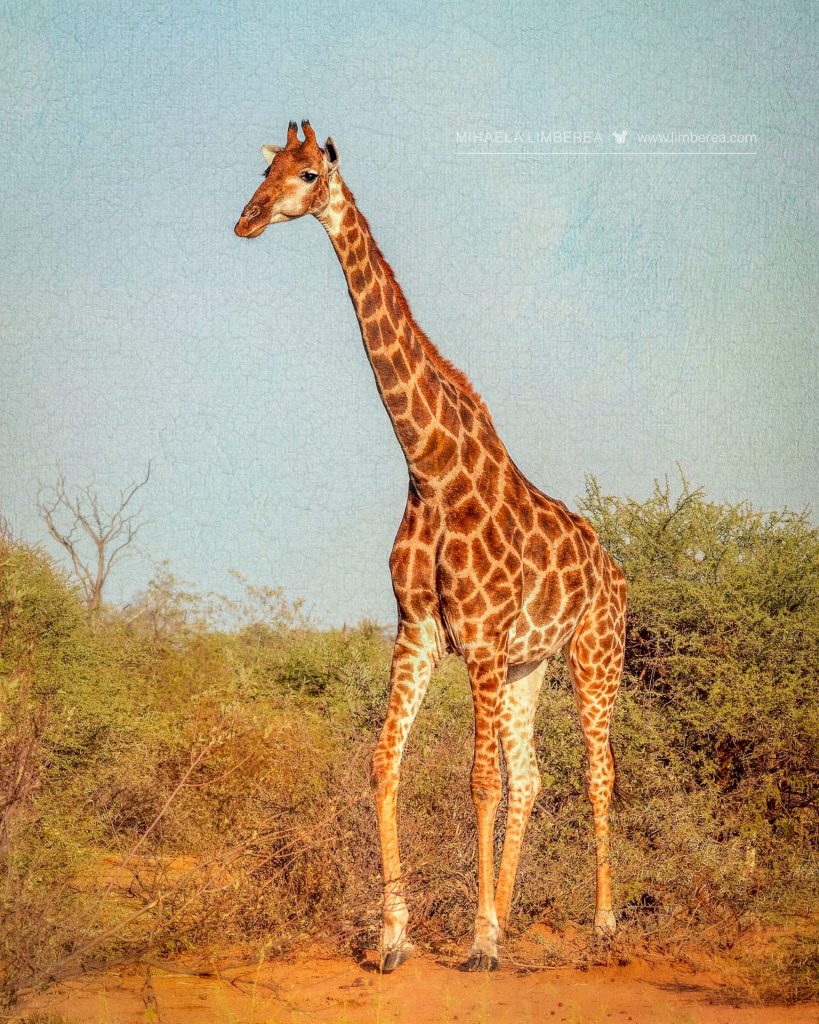
Tag: Giraffe

How To Shoot and Edit Black-and-White Wildlife Photos

This is the third of four posts about shooting and editing wildlife photos for different creative results on safari. We’ll look at high-key, low-key, black-and-white, backlit & silhouette. Each style offers a unique way to see and a different set of choices, both when you’re out in the field and when you’re editing. While I’m focusing on a South African safari, these ideas work anywhere you’re photographing wild animals.

I use Canon equipment for all my photos, but I’ve tried to avoid using brand-specific terms wherever possible. My main post-processing tools are Lightroom Classic and Photoshop, and my guide starts from there, but I kept the details general, and they would apply to most post-processing software.

Today, we’ll continue with the black-and-white style.

Portrait of a lion (Panthera leo) in black-and-white
Lion, South Africa. Side light carves out every ridge in this mane, the kind of texture a color photo would let you skim past. In monochrome, there’s nowhere else to look.

I have to admit something about black-and-white photography. For a long time, I only used it to save photos that didn’t work in color. If the sky looked dull, the background was distracting, or the colors just clashed, I would switch to monochrome. It was always a last-minute fix, not a choice I made from the start. The photos turned out okay, and sometimes even better than okay, but they never felt quite right because I was working in reverse.

Everything changed when I began studying photographers who chose black-and-white from the beginning, not as a backup. Ansel AdamsNick BrandtArt Wolfe, to name just a few. What stood out wasn’t just the lack of color, but a special focus on light, shape, and texture that color photos don’t always require. These photographers weren’t just taking color away; they were seeing the world without it from the very beginning.

This difference, between taking color out and not needing it at all, is what I want to talk about here. It sets the stage for everything that follows.

This photo depicts a young lioness in the midst of a hunt on a sunlit savanna. Her lean, muscular frame is poised low to the ground, with her coat blending into the dry grass as she stalks prey. Her eyes are intensely focused, ears slightly back, and her mouth is open, revealing sharp teeth.
Lioness, South Africa. The high-key processing did what a backdrop rarely does on its own: flattened everything behind her into a single pale tone, so the eye has nowhere to go but her face. This is the kind of scene the black-and-white questions are built for — not “is the light good,” but “is there enough here without color.”

Why Monochrome Is a Different Way of Seeing

Color does a lot in a photo. It helps the subject stand out, sets the mood, catches your attention, and even tells you about the species, season, or time of day. When you take color away, all that work shifts to other things, like how the light falls, the range of tones, the shapes in the picture, and how they relate to each other.

That’s why turning a so-so color photo into black-and-white rarely works well. If color was doing most of the work, removing it leaves nothing behind. A good black-and-white photo needs to be strong in the ways that matter for monochrome, and those qualities have to be there in the scene itself, not added later.

When you’re on safari, you have to start asking new questions when you see something interesting. Instead of just asking if the light is good, ask if the scene has what black-and-white needs. Is there enough contrast between the subject and the background, even without color? Does the light bring out shapes and textures? Is there something graphic in the composition, like a bold silhouette, a repeating pattern, or a strong line, that will stand out without color?

These questions are tougher than those you ask with color photography, and they take some practice. But the photos you get are different in more ways than just color. That difference is important, especially when we start talking about light.

Close-up of a lioness in black-and-white

Lioness, South Africa. A quieter version of the same idea — flatter light, softer shadows, but the eyes still hold the frame as in the lion portrait. Two lions, two different kinds of light, and the same lesson: monochrome asks the most of a face.

The Light That Works 

Not every kind of light works the same in black-and-white. The best light for striking black-and-white wildlife photos is often the same light that makes color photos dramatic, but for different reasons. I’ll explain why as we look at different types of light.

  • Side light from the low sun in the early morning or late afternoon creates strong shadows that show off a subject’s shape. On a lion’s mane, an elephant’s wrinkles, or a bird’s feathers, this kind of light creates rich tones that look great in black-and-white. The texture you see isn’t added later, it’s captured by the light itself.
  • Backlighting and rim lighting work in their own way, but they’re just as effective. When a subject is outlined by bright light against a dark background, it creates a bold, graphic look that suits black-and-white perfectly. The color of the rim light doesn’t matter; what counts is how the bright edge stands out against the dark.
  • Overcast light, which I’ve discussed before when talking about flat light, is especially useful for black-and-white portraits. This soft, even light shows off every detail and texture on your subject. Close-up portraits of animals—where you can see every hair and whisker—often look better in black-and-white because color can distract from the texture that overcast light brings out.
  • Stormy skies also work well. The contrast between a bright subject and a dark, heavy sky stands out even more in black-and-white. Clouds that look dramatic in color can feel truly powerful in monochrome.

A Tool Worth Using in the Field

Most new mirrorless cameras have a monochrome preview mode. This setting lets you see the scene in black-and-white through the viewfinder and on the screen, but the camera still saves a full-color RAW file. The RAW file keeps all the color data for editing later, but you get to see the scene in black-and-white as you shoot.

This is a great tool for learning to see in black-and-white, but many people don’t use it enough. With the monochrome preview on, you can check the contrast between your subject and the background before you take the shot. You can see if the light brings out shapes and textures, and decide if the sky helps or hurts the picture based on tone, not color. This way, you can decide about black-and-white right there in the field, not just later on your computer.

Try leaving the monochrome preview on for a whole game drive, especially on days when the light isn’t great, when it’s overcast or flat, and not what you wanted. You might discover that without color to distract you, you start to see things in a new way.

In the Field

Besides using the preview mode, there are a few camera settings you should adjust if you plan to turn your photos into black-and-white later.

Zebra, South Africa. Stripes are already halfway to black-and-white before you press the shutter. Backlit and dusted with the dry haze of the road, this one barely needed the conversion — the graphic pattern was always the point.

  • Expose to the right, just like you would for high-key shots. Move the histogram as far right as you can without losing detail in the subject. A well-exposed RAW file gives you more tones to work with when you convert to black-and-white. While monochrome can forgive some mistakes, it’s best to start with a clean, well-exposed image.
  • For autofocus, Animal Detection works well with black-and-white photos. The contrast between a well-lit subject and a dark background helps the autofocus system find clear edges. Take advantage of this feature.
  • One setting to switch off is Auto Lighting Optimizer, for the same reasons that apply across all the posts in this series. It compresses the tonal range, the very range you will need intact for a meaningful conversion.

Post-Processing

The most important tip for editing black-and-white photos: don’t just desaturate the image or switch to greyscale. Both methods throw away the color channel information you need to control how each color turns into a shade of grey.

The right way is to use the Black and White panel in Lightroom or the Black and White adjustment layer in Photoshop. These tools let you control how each color channel appears in greyscale. This isn’t just a technical detail, it’s what separates a flat, lifeless image from one with real depth and contrast.

In Lightroom’s Black and White panel, eight color sliders control how each color in the original image is translated to grey. The ones that matter most for safari photography are these:

The image features a detailed, black and white, close-up depiction of a giraffe's head and neck. The giraffe is positioned in the lower left of the frame, with its head tilted and turned towards the viewer, creating a comical expression. Its mouth is open, with its tongue visible and curled upwards, and its lips appear to be puckered or pursed, giving the impression of it making a silly face or sticking its tongue out.
Giraffe, South Africa. Overcast light does its best work on close portraits like this one — soft and even, with nothing to distract from the texture. Every hair on this giraffe’s neck holds up because the light gave it something to hold.
  • The Green slider affects vegetation like grass, leaves, and bushes. If you move it down, the background gets much darker, which helps your warm-toned subject stand out from the green background. This is one of the best adjustments for safari black-and-white photos, and you can’t get this effect by just desaturating.
  • The Blue slider controls the sky. Move it down, and the sky gets much darker, just like using red or orange filters in film photography. Clouds that were hard to see in color become bold shapes against the dark sky. Even a flat, overcast sky can look more dramatic. 
  • The Orange and Yellow sliders adjust warm-toned subjects like lions, cheetahs, sandy-colored antelopes, and golden grasses. Raise these sliders to make warm subjects stand out against a background darkened with the green and blue sliders.

This separation between subject and background in monochrome works like a well-exposed color photo: the subject is clear, the background supports it, and nothing distracts.


Once you’ve converted the image, go back to the Basic panel and take another look. You’ll usually need to boost Contrast, Clarity, and Texture more in black-and-white than in color. Black-and-white photos handle these changes well, and the result is an image with rich tones and lots of detail.

For the final touches, try dodging and burning. In Photoshop, use a 50% grey Overlay layer and apply the Dodge and Burn tools at low opacity, building up the effect gradually. This method comes from traditional darkroom work and has been adapted for digital editing. It takes time and patience, but it gives results you can’t get with global adjustments. If the photo is important, it’s worth the effort.


The question I began with, what’s left when you remove color, actually has a clear answer. What’s left is light. Not light as warmth, color, or mood, but light as information: how it falls on a surface, the shadows it makes, the edges it shapes, and the textures it shows. That’s what black-and-white photography explores. At its core, it’s about studying light without the usual distractions.

That is a narrower subject than color photography. It is also, in the right hands, a more demanding focus. This focus is narrower than color photography, but in the right hands, it’s also more challenging and more revealing.


Related Posts


Love my work? Support my journey by buying me a coffee or sharing it on your preferred social network. And don’t forget to swing by my online shop to check out my latest prints and gifts. Thank you 🙏 !

Follow me on Instagram | Facebook | Threads | LinkedIn | Tumblr | X | Buy Me A Coffee 


Favorite Photos: April 2026

  1. My 2022 Favorite Photos
  2. Favorite Photos: January 2023
  3. Favorite Photos: February 2023
  4. Favorite Photos: March 2023
  5. Favorite Photos: April 2023
  6. Favorite Photos: May 2023
  7. Favorite Photos: June 2023
  8. Favorite Photos: July 2023
  9. Favorite Photos: August 2023
  10. Paris Is Always A Good Idea
  11. Favorite Photos: October 2023
  12. Favorite Photos: November 2023
  13. Favorite Photos: December 2023
  14. My 2023 Favorite Photos
  15. Favorite Photos: January 2024
  16. Favorite Photos: February 2024
  17. Favorite Photos: March 2024
  18. Favorite Photos: April 2024
  19. Favorite Photos: May 2024
  20. Favorite Photos: June 2024
  21. Favorite Photos: July 2024
  22. Favorite Photos: August 2024
  23. Favorite Photos: September 2024
  24. Favorite Photos: October 2024
  25. Favorite Photos: November 2024
  26. My 2024 Favorite Photos
  27. Favorite Photos: December 2024
  28. Favorite Photos: January 2025
  29. Favorite Photos: February 2025
  30. Favorite Photos: March 2025
  31. Favorite Photos: April 2025
  32. Favorite Photos: May 2025
  33. Favorite Photos: June 2025
  34. Favorite Photos: July 2025
  35. Favorite Photos: August 2025
  36. Favorite Photos: September 2025
  37. Favorite Photos: October 2025
  38. Favorite Photos: November 2025
  39. My 2025 Favorite Photos
  40. Favorite Photos: December 2025
  41. Favorite Photos: January 2026
  42. Favorite Photos: February 2026
  43. Favorite Photos: March 2026
  44. Favorite Photos: April 2026
  45. Favorite Photos: May 2026
  46. Favorite Photos: June 2026
  47. Favorite Photos: July 2026
  48. Favorite Photos: August 2026
  49. Favorite Photos: September 2026 Scheduled for 6th October 2026
The image shows a serene water scene focusing on a single white water lily with delicate petals and a vibrant yellow center. A small bee, its body striped with yellow and black, is perched on the center of the lily, actively engaged in collecting nectar.
Water lily, Matlabas river, South Africa

When Life hands you lemons… We were floating slowly on Matlabas River in South Africa, hoping to find hippos. We could hear them somewhere in the distance, and kept going, but never found any. We had to turn back eventually, empty handed, tail firmly tucked between our legs. Still, I had my camera, and the scenery was beautiful. Water lilies were blooming, and I found one just begging to be photographed.

I didn’t get any hippo photos that morning, but I did take lots of pictures of the landscape and flowers. This water lily, glowing in the sunlight, became one of my favorite photos from the trip.

This is a high-key close-up photograph of a giraffe making a funny face against a plain white background.
Giraffe in High Key, Marakele National Park, South Africa

Another round of lemons being handed out, during the same safari. Later that very same day, in fact. We left the river and went on a typical game drive, and hoped to spot lions we’d heard were in the area. No lions appeared. 

We found a tower of giraffes eventually. (Don’t you like that name for a group of giraffes, tower?). It was late morning, the light was harsh, and the giraffes were busy eating, completely ignoring us. We hanged around for a while, hoping something interesting might happen, but this giraffe doing some tongue calisthenics was the only notable thing.

I did take a few photos, though, and I liked this one eventually, I think it works pretty well in high key.

The tongue of a giraffe is one of those details that feels almost invented when you first learn about it. But it’s all very real, and quite remarkable, really.

Here are some of the most interesting facts:

1. It’s incredibly long
A giraffe’s tongue can reach about 45–50 cm (18–20 inches). That length isn’t just for show; it allows them to reach deep into thorny branches to grab leaves other animals can’t reach.

2. It’s dark, almost black or purple
The tongue’s dark color is thought to help protect it from sunburn. Giraffes spend hours feeding in direct African sunlight, so this pigmentation likely reduces UV damage.

3. It’s prehensile (like a hand)
A giraffe can grasp, twist, and pull with its tongue. Combined with its flexible upper lip, it can delicately strip leaves from branches, even around sharp thorns.

4. Built for thorny meals
Giraffes commonly eat from acacia tree species. Their tongues and mouths are tough and covered in thick saliva, which helps protect them from cuts while navigating thorns.

5. Extremely strong and dexterous
Despite its softness, the tongue has powerful muscles. It can wrap around branches and pull leaves into the mouth with precision.

6. Surprisingly resistant to injury
Between the thick saliva and the tough surface of the tongue, giraffes can repeatedly eat spiky plants without obvious harm, something that would shred most other animals’ mouths.

7. It plays a role in cleaning
Giraffes can use their tongues to clean their noses and even their ears. It’s a slightly odd but very practical feature given their long necks.

The image features two great crested grebes swimming on a pale blue, calm body of water. The grebes are the primary subjects, positioned in the lower half of the frame. The grebe on the right is slightly larger and further back, facing towards the left and slightly away from the viewer. It has striking reddish-brown cheek tufts and a black crest on its head, characteristic of the species. Its plumage is a mix of brown, black, and white, with visible feather detail. The grebe on the left is closer to the viewer and positioned slightly forward and to the left of the other grebe.
Great crested grebes, Lidingö, Sweden
wo Great Crested Grebes are captured in a moment of interaction on the surface of calm water. The bird on the left is closer to the foreground and is looking to the left. It has its head held high, with its distinctive crest visible, and its beak is closed. Its body is positioned parallel to the water's surface. To the right and slightly further away is the second grebe. This bird's head is turned towards the bird on the left, and its beak is wide open, as if it is calling out or vocalizing. Its crest is also visible, though perhaps less prominent than the first bird's. The body of this grebe is also horizontal on the water.
Great crested grebes, Lidingö, Sweden

A great crested grebe pair (Podiceps cristatus) I photographed on a chilly April morning near my house. Living on an island with so many nature reserves and so much wildlife is something I really appreciate every single day.

The image is a close-up shot focusing on a single peacock butterfly resting on a bright pink coneflower (Echinacea). The butterfly, with its wings spread, displays the striking patterns characteristic of its species.
Peacock butterfly on echinacea, Lidingö, Sweden

Here’s a photo from my garden: a peacock butterfly (Aglais io) on echinacea (Echinacea purpurea var. Magnus).

I love my garden because it attracts so much diverse wildlife that I hardly need to leave home to have something to photograph. Most flowers and bushes are pollinator-friendly; trees and shrubs provide shelter and food to birds and small animals, and several bird baths, in various sizes and depth, provide water to all creatures.


📸 All photos were taken with Canon R5 Mark II & Canon RF100-500mm F4.5-7.1 L IS USM.


Related Posts

To view all my favorite photos archive, click here.


Love my work? Support my journey by buying me a coffee or sharing it on your preferred social network. And don’t forget to swing by my online shop to check out my latest prints and gifts. Thank you 🙏 !

Follow me on Instagram | Facebook | Threads | LinkedIn | Tumblr | X | Buy Me A Coffee 


How The Giraffe Got Its Long Neck

Giraffe

This is a charming African story explaining the long neck of the Giraffe.

In the beginning, the Creator gave the Giraffe the same legs and neck as all the other animals; in fact, the Giraffe resembled the larger antelope. All was well until the drought came.

As the best grazing and browsing were eaten, the animals began to go hungry. One day, Giraffe and his friend Rhino were talking, “Oh, Rhino, there are too many animals looking for grass on the plains; all they do is trample the last remaining grass.” Despite the dire situation, Giraffe’s determination to find a solution was unwavering.

Rhino suggested they go see the man-magician, a wise and powerful figure known for his ability to solve problems. After they told him their story, the man-magician told them to come back at noon the following day, and he would help them.

Giraffe, filled with hope, went to see the man-magician. They waited and waited for Rhino, who, unfortunately, had forgotten the plan.

Finally, the man-magician gave the Giraffe all the magic medicine, including Rhino’s share. That potent potion made his neck and legs grow long. Since that day, Giraffe has been able to feast on the succulent leaves on the treetops, which he now has all to himself.


Related Posts


If you liked this post, share it on your preferred social network or forward it to a friend.


Favorite Photos: June 2024

  1. My 2022 Favorite Photos
  2. Favorite Photos: January 2023
  3. Favorite Photos: February 2023
  4. Favorite Photos: March 2023
  5. Favorite Photos: April 2023
  6. Favorite Photos: May 2023
  7. Favorite Photos: June 2023
  8. Favorite Photos: July 2023
  9. Favorite Photos: August 2023
  10. Paris Is Always A Good Idea
  11. Favorite Photos: October 2023
  12. Favorite Photos: November 2023
  13. Favorite Photos: December 2023
  14. My 2023 Favorite Photos
  15. Favorite Photos: January 2024
  16. Favorite Photos: February 2024
  17. Favorite Photos: March 2024
  18. Favorite Photos: April 2024
  19. Favorite Photos: May 2024
  20. Favorite Photos: June 2024
  21. Favorite Photos: July 2024
  22. Favorite Photos: August 2024
  23. Favorite Photos: September 2024
  24. Favorite Photos: October 2024
  25. Favorite Photos: November 2024
  26. My 2024 Favorite Photos
  27. Favorite Photos: December 2024
  28. Favorite Photos: January 2025
  29. Favorite Photos: February 2025
  30. Favorite Photos: March 2025
  31. Favorite Photos: April 2025
  32. Favorite Photos: May 2025
  33. Favorite Photos: June 2025
  34. Favorite Photos: July 2025
  35. Favorite Photos: August 2025
  36. Favorite Photos: September 2025
  37. Favorite Photos: October 2025
  38. Favorite Photos: November 2025
  39. My 2025 Favorite Photos
  40. Favorite Photos: December 2025
  41. Favorite Photos: January 2026
  42. Favorite Photos: February 2026
  43. Favorite Photos: March 2026
  44. Favorite Photos: April 2026
  45. Favorite Photos: May 2026
  46. Favorite Photos: June 2026
  47. Favorite Photos: July 2026
  48. Favorite Photos: August 2026
  49. Favorite Photos: September 2026 Scheduled for 6th October 2026
Close-up of a lion

The King.

As you may have seen from my Instagram stories, I went on a safari in South Africa, a truly awe-inspiring experience. We spent ten incredible days first in the Marakele National Park, Thabazimbi, and then in the Lapalala Wilderness Reserve, where we were privileged to witness animals in their natural habitat, a sight that never ceased to amaze us.

A lion walking in the early morning light.

A lion strolling leisurely through the Lapalala Wilderness Reserve bathed in the gentle glow of the early morning light.

A lion resting in the early morning light.

Captivated by the serene beauty of the wilderness. Witnessing this majestic lion immersed in the soft morning light was truly an unforgettable experience.

Two giraffes

Chasing giraffes and zebras! 🦒 Spotting giraffes in their natural habitat is always the highlight of any safari for me. I absolutely love animals with spots or stripes, so this was a dream come true. While some people rushed to look for the Big Five, I went after giraffes and zebras, LOL. 

I captured this photo in Marakele National Park, Thabazimbi, our first stop. During our visit, we spent a few days at the Marataba Mountain Lodge, featuring only five suites and offering a breathtaking view of the nearby mountains. Situated in a privately managed area within Marakele National Park, the lodge is approximately a 3-hour and 30-minute drive from Johannesburg.

Walking cheetah

Imagine the thrill of spotting a young male cheetah on a beautiful golden afternoon while walking just a few meters behind him! It was just my husband, our experienced guide Brendan Vorster (IG: @brendans_wildlife), and me alone in the long grass; the quiet scene occasionally interrupted by the calls of birds and the sound of the wind rustling through the tree leaves. It was an unforgettable experience that we’ll always cherish. 

The cheetah (Acinonyx jubatus), the fastest land animal, can sprint at an astonishing 93 to 104 km/h (58 to 65 mph). Its body is uniquely designed for speed, with a slender build, long, thin legs, and a lengthy tail. The semi-retractable claws, a distinctive feature not found in other cats, play a crucial role in its remarkable speed.  

*

Lapalala Wilderness Reserve was our second safari destination. We were incredibly fortunate to be accommodated at the Noka Camp, one of the renowned Lepogo Lodges. The five villas, perched on a striking 100-foot clifftop, not only offered awe-inspiring views over the Palala River but also provided a lavish and cozy stay. The lodge, a few hours’ drive from Johannesburg, is completely malaria-free, a key factor in our decision to choose it.

Close-up of two cheetahs

Brotherly love at its finest. These two cheetah brothers always have each other’s backs.

Two walking cheetahs

Double trouble. Two young cheetah brothers walk gracefully in the Lapalala Wilderness Reserve on a golden afternoon, the epitome of grace and speed. They moved effortlessly at a seemingly slow pace, yet we could barely keep up with them.

Close-up of an elephant with a baby

Mesmerized by the gentle strength and protective nature of this beautiful female elephant with her adorable baby following closely behind. 🐘💕

Elephant breeding herd

An elephant breeding herd in the breathtaking Marakele National Park, what an awesome sight! The mother in front was very protective of the baby, stirring up dust, flapping her ears, and trumpeting vigorously to keep us away.


Stay tuned, because I’m bursting with excitement to share more from this unforgettable adventure with all of you!


Related Posts


If you liked this post, share it on your preferred social network or forward it to a friend.